Main

Religion Archives

November 24, 2002

Dogmatic Questions

So I’ve been thinking about religion… trying to figure it out, I guess. I’ve got a couple questions that seem to need answering:

  • How do we have free will? All of our actions are connected biologically to nerve impulses, which are in turn connected to other nerve impulses, chemical gradient changes, and electrical potential changes, in a predictable manner. Where does free will fit in?
  • God created Adam and Eve in the Garden of Eden, and also created a Tree of Knowledge which he instructed them not to touch. Why? Does this indicate that knowledge is wrong or evil? Was the serpent in the tree Lucifer before or after the great fall (did the great fall happen before or after the separation of the earth from the heavens?)? Were Adam and Eve set up to fail?
  • Why and how does the devil exist? Why throw Lucifer out of heaven instead of uncreate him? How could an angel think such things without God’s knowledge in that he designed them?
  • Is God subject to time?

May 11, 2003

Descartes

I found a fun cartoon about Descartes "proof" for the existence of God. Here!

November 20, 2003

Gay Rights

A little background first... I subscribe to CRISIS Magazine's e-newsletter. It's a hyper-conservative Catholic magazine, and every so often (once a week or so) they send out a newsletter with the latest bits of news in conservative Catholic circles. I subscribed because I saw an ad advertising "10 Things Every Catholic MUST Know", and was curious. I've kept it... well, because it's as informative as it is infuriating. Anyway... So I got an email from them today, giving kudos to the Senate for voting (unanimously) to award the Pope a Congressional Medal of Freedom, and noting that Archbishop O'Malley of Boston said something that could be construed as giving the Voice of the Faithful organization approval, and finally discussing the recent goings-on in Massachusetts. First, the Voice of the Faithful... it's a group of Catholics who would like a little bit more democracy and flock-based influence in the decisions of the Catholic hierarchy. This is a simplistic way of looking at them, but check their website and make your own decision on that score. I find it interesting that hardline conservative Catholics are against this... but on the other hand, it's nontraditional, non-authoritarian, and in all other ways a new idea. Obviously, conservatives will reject it. I just hadn't thought it would be objectionable. Ah, well... Now, the goings on in Massachusetts... If you haven't been paying attention, the Massachusetts Supreme Court recently decided that denying gay people the right to marry each other was contrary to the state's constitution, and therefore laws that did that must be changed---they gave the legislature 180 days to fix it (it being the existing laws that prevent gay marriage). CRISIS is, predictably, not happy with this situation, for a myriad of reasons mostly stemming from their belief in the moral authority of Leviticus, which has a passage that is frequently construed as banning homosexual activity. The basis of the belief is, as I said, passages in Leviticus, a chapter of the Old Testament. The Old Testament, and particularly Leviticus, is a listing of ancient Jewish civil laws, including among other things a prohibition from touching the skin of a pig (outlawing football) and allowing you to sell your children into slavery and mandating that you kill people who work on Saturday. So, obviously, it's a strict authority (nevermind that Jesus essentially said "look, these laws are getting out of hand, that's not how you get into heaven, listen to me, I'll tell you how things are."). Additionally, the passages in question (and the ones surrounding them) are specifically talking about pagan temple prostitutes, not the general populace. (There are much more thorough explanations out there... here and here for example) So, big whoop, they're misinterpreted and misapplied. The interesting part of the argument that CRISIS makes is that marriage confers certain benefits in our society, from health insurance to the right to see and/or make decisions about your partner when they are having severe medical difficulties. These benefits are mandated by law, and if gay marriage becomes legal, could be forced upon conservative churches and charities that find such things to be contrary to their beliefs. To be honest, I hadn't thought about it like that before. On the other hand, when we decided to integrate schools and to make it illegal to force black people to use different drinking fountains, we had to deal with lots of people who didn't like it (some people even believed (religiously) that black people were not human). That's what happens when society decides you're WRONG. The argument, however, is that this is censorship. HOW??? People disturb me.

November 23, 2003

Why do Catholics Genuflect?

I thought I had this one down… but I guess I don’t. Why do Catholics genuflect? I thought the reason why Catholics genuflected before they did stuff (like read a passage or something) was in deference to the Host (which, as we all know, is THE body of Christ—as holy as it gets). But I was just at a mass where they were genuflecting just because, to THE BIBLE. Which prompts me to wonder—why on earth would you genuflect to the Bible? They’ve got giant boxes of the things, they hand them out on street corners, there’s one in every hotel room. If we generally genuflected to the Bible, people would be genuflecting all day! I don’t get it.

Of course, thinking along these lines prompts me to wonder about something else. I’ve noticed that at every mass the priest kisses the words of the Gospel after he reads them. Why? They’re God’s Words, surely, but it’s just ink and paper. We don’t worship the words—they’re just words, it’s the IDEAS that are the really important bits. The Words are only important in as far as they convey God’s Will. Writing the Words down in the Bible is like drawing a picture—they both stand for something else! We don’t treat a picture of a king as the King, we don’t treat a Stephen King novel as Stephen King, why would you treat a late edition of the Bible that way?

This makes no sense at all.

May 11, 2004

When Jesus Said...

I saw a bumper sticker that I liked recently. It said: "When Jesus said 'Love Thine Enemy' I think He meant don't kill him."

July 17, 2004

Food for Thought: Divorce and Religion

I found an interesting reference today. It seems there’s a group out there called the Barna Research Group, a Christian research group that does a lot of research into statistics surrounding religion in America, among other things. One of their more surprising findings, as paraphrased by Freethought Today is: Born Agains More Likely To Divorce . Now, that’s a hell of a claim. But, if you go to the Barna website , it’s true! Back in 2000, they did a study and found that:

Born again adults are more likely to experience a divorce than are non-born again adults (27% vs. 24%).

(It’s on that page under “7 Most Discouraging Results.”) That’s a pretty interesting statistic, and I’m sure I don’t have to say why. They don’t say what the margin of error on their study might be, but it’s still interesting. Now, this isn’t the most recent research. A mere six months later, they performed a more in-depth study , and found that things were not as bad as that. Instead they found that Born Again Adults Less Likely to Co-Habit, Just as Likely to Divorce —in fact, that’s the title of the study. Which means that religion is NOT a deterrent to a stable marriage, thank Heaven. But it certainly doesn’t point to religion being a stabilizing factor.

It occurs to me that the idea that co-habitation is a bad thing is rather debunked by this study as well, regardless of the fact that it’s referred to with such a disappointed tone. If co-habitation is lower in born-again Christians, and yet has no net positive effect on their divorce rates, either cohabitation has no effect on divorce (and thus shouldn’t be regarded as a bad thing strictly for it’s effect on divorce) or something more complicated is going on (such as the difference in religion and co-habitation off-setting each other with a net-null effect on the stability of marriage). Either way, an intriguing factoid.

Something else that’s interesting to point out: Salon , in this article make reference to this statistic (which is what got me interested). Seems rather unfortunate that they use the older statistic, instead of the newer one—-and even that is almost 3 years old now. Kinda makes you wish they provided references for their articles, doesn’t it?

Still, all in all, good food for thought.

July 19, 2004

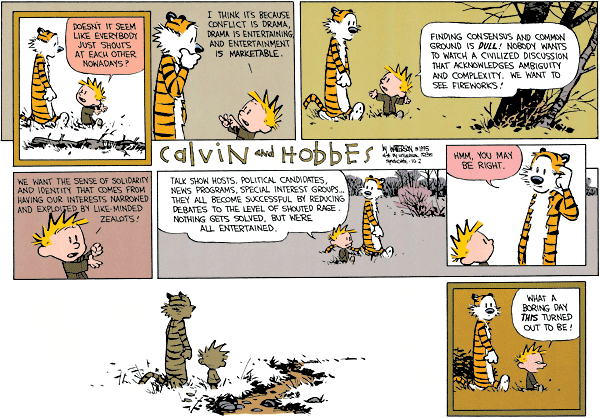
Revisionist History

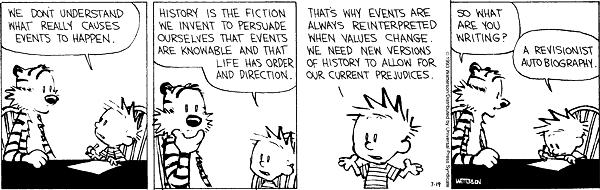
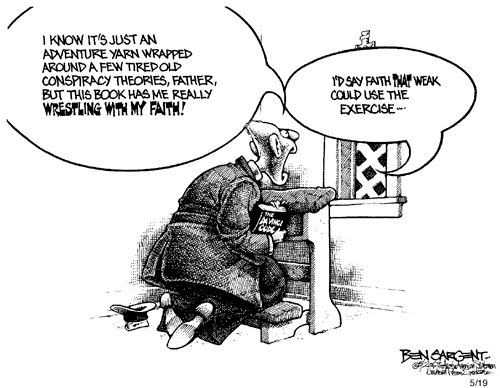
revisionist_history.gif An interesting commentary. Gads, I love Calvin and Hobbes—not because I think they're always right, but because they come up with some really insightful observations.
August 21, 2004

The Real Deal

I have, for a while now, subscribed to the CRISIS Magazine email newsletter. I know the author, Deal Hudson, is extremely conservative, and obviously, I don’t agree with him about a lot of things (I should point out that at least one of his email newsletters consisted of three stories that I liked). I primarily subscribe to it to get an opposing viewpoint, and an idea of what is going on in the conservative world.

I have since discovered that not only is CRISIS Magazine published by the Notre Dame press (or was, at one point), which makes me more interested (as a student of Notre Dame myself), but Deal Hudson is quite the Washington power broker.

I have also discovered that Deal Hudson is a hypocrite, and an adulterer. He must have found it interesting that Clinton did exactly the same thing he did. That, however, did not stop him from writing that it is a “lie that a person’s private conduct makes no difference to the execution of their public responsibilities. It’s this lie, alive in our culture of death, that has shaped the character of Bill Clinton and encouraged the moral softness in all of us.”

Anyway, I digress. The National Catholic Reporter is a newsmagazine that generally focuses on Catholic-related news issues. As Deal Hudson is Catholic and (was) quite possibly the most powerful Catholic lay-person in the country (he had/has the ear of the Bush administration), they did a profile about him. In so doing, they discovered Hudson’s past. They sent a letter to Hudson asking for a comment so they could do their story. Instead of responding to them, he published a preemptive (conservatives like that word, don’t they?) letter on the National Review’s website in an attempt to discredit or mitigate the effect of the NCR’s unpublished article. That article is now published, and is available here It’s a real humdinger, and a long article at that (it was supposed to be a chronicle of Hudson’s rise to power and influence, and was intended to be long), but it’s very worth the read.

Deal? You are an interesting piece of work.

October 26, 2004

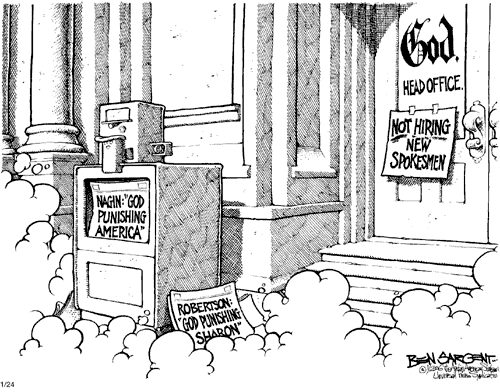
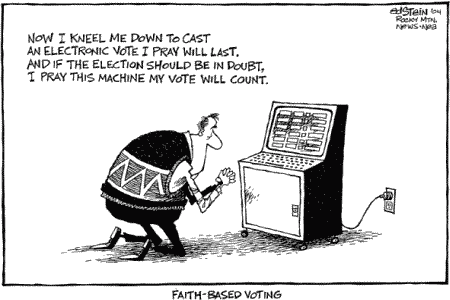
Faith-Based Voting

faith-based-voting.gif

heh, it’s too true to be funny.

October 29, 2004

Jews and Jesus

On this day, in 1965, Pope Paul VI forgave the Jews for killing Jesus.

Nearly two millennia after the fact.

Yeah, that’s about what I thought too.

I ask you, what sort of moral authority can a church have to speak about “forgiveness” when they carry that kind of a grudge that long?

December 4, 2004

Nazis

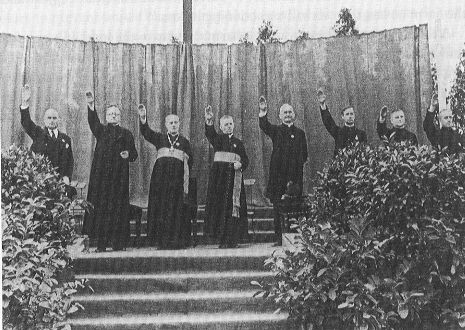
I want to preface this with the statement that I’m not saying the Catholic Church endorsed the Nazis. On the contrary, it did not, as documented here and here . To wit, Pope Pius XII said in the late 1930’s (he was still a Cardinal at the time) that “Belonging to the National Socialist Party of Hitler is irreconcilable with the Catholic Conscience.”

But the following certainly is interesting, isn’t it?

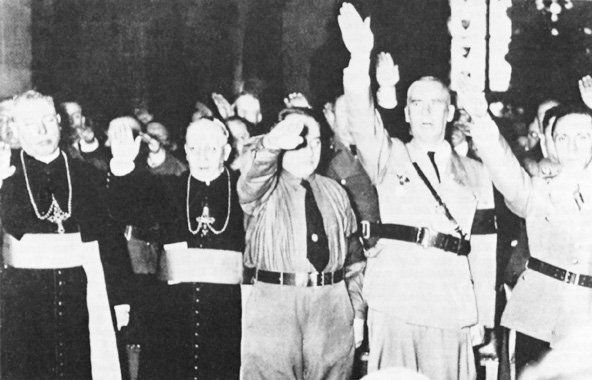
I found this and was astonished. There’s a whole page of them. Here’s an example:

original

Those are all Catholic priests.

So are these:

original

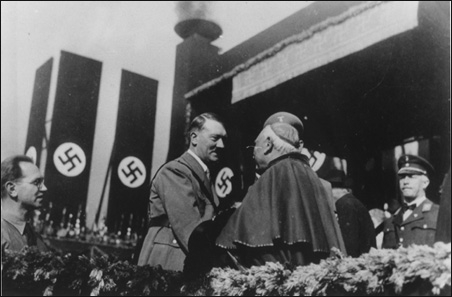
This is a Catholic Cardinal:

original

February 1, 2005

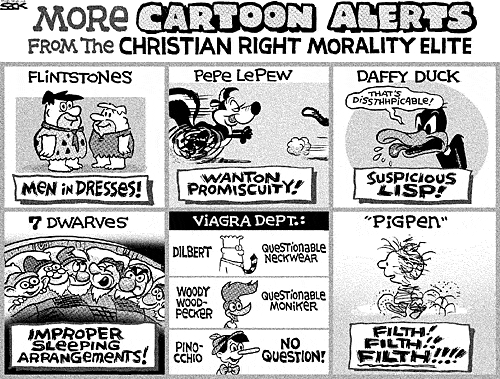
Suspicious Cartoons

Ah, SpongeBob, how little we knew ye. I think this is hilarious:

February 16, 2005

Indulgences

I was pointed at this by a friend (Rich). A different perspective on the concept of indulgences than the one I usually think of (with the whole “buying your way out of hell” thing). What seems key to me is that sin generates not only damnation (estrangement from God), but punishment. Forgiveness alleviates damnation, while indulgence alleviates punishment.

Next question: if your parents are in heaven, will they be pleased to know you are undergoing punishment? Is that truly heaven for them? What about your spouse (if you have one)? Is “ignorance is bliss” a part of the nature of heaven?

How does “ignorance is bliss” translate to the idea that in the story of Adam and Eve, it was the Tree of Knowledge whose fruit they ate? Is heaven a return to ignorance, and a loss of all kinds of knowledge in return for happiness?

Is that a trade I would make?

February 21, 2005

Religous Ponderings

So, some thoughts…

First, Cosby was wrong. He said that God made all sorts of creatures, and saw that they were good. But then He made man, and DIDN’T say that man was good. Cosby was WRONG. Read Genesis, chapter 1 - line 27, God creates man. Here’s the critical one, line 31: And God saw all the things that he had made, and they were very good. And the evening and morning were the sixth day. Eat that, Cosby.

Yeah, yeah, debunking comedians is shooting fish in a barrel. I’m just saying. Otherwise, it’s a really funny bit that he does on the Bible.

Now, I’ve talked to Emily, and one of the things she’s pondered is the question, “What is the purpose of marriage?” Why get married? What’s the point? She asked a bunch of people, and the only person who gave her an answer that she could hold on to and really believe was her mom, who said: the purpose of marriage is to have children.

Now, this answer bothers me. It’s so means-to-an-ends-ish, you know? It seems to me that one should get married because you want to get married, not because you want kids. I mean, if kids is all you want, go to a sperm bank or something; marriage is a commitment not to yourself and your own genes, but it is a commitment to the person you’re marrying. That’s the big deal, when you get married, you say “I wanna marry THIS person.” I believe there’s a REASON for that, and it’s not just “well, that’s what you need to say and feel and that’s the attitude you need to have if you wanna raise your kids in the right atmosphere.” If marriage is just a waypoint en route to having children, why is marriage a sacrament, and not birth?

I was reading one of the books Emily gave me, “The Truth of Catholicism: Ten Controversies Explained” by George Weigel. Weigel wrote Pope John Paul II’s bibliography, so he’s very conversant with John Paul’s philosophies and writings… though some of what Weigel says has a tendency to make logical leaps that look rather larger than I want to go. Anyway, one of the ten controversies he addresses is the Catholic Church’s position on sex and love, and I found a passage I like:

The judgement that the Catholic Church is both prudish and sex-obsessed is deeply entrenched in the Western world today. Catholics and non-Catholics alike believe it. The mass media assumes it. It’s simply the way things are, to hundreds of millions of people.

But it’s not the way things really are.

Deconstructing the myth of Catholic prudishness and engaging the Catholic sexual ethic for what it really is—namely, an affirmation of the gift of sexuality—means recognizing that the Church itself contributed to the myth’s formation. In its first centuries, Christianity decisively rejected the Manichaean heresy, which held that the world was inherently polluted, and took a theologically grounded stand against the claim that sexual love was intrinsically evil. The Church taught that to deprecate sexuality was to deny the great biblical truth contained in Genesis 1.31: “God saw everything that he had made, and behold, it was very good.” Unfortunately, that principled affirmation of sexual love as one of the goods of God’s creation frequently got lost over the centuries in a brier patch of theoretical confusions and legal entanglements.

Catholicism taught that marriage was a vocation, included marriage among the seven sacraments, and insisted that the couple, expressing their love through consent and sexual intimacy, were the ministers of the sacrament of matrimony. Yet for centuries the Church also taught a theory of the “ends,” or purposes, of marriage that too often turned into a denigration of sexual love. According to this theory, the “primary end” of marriage, and of sex, was the procreation and education of children. The sexual deepening of married love and the sexual contribution to the communion of husband and wifew were relegated to what the old theory called marriage’s “secondary ends,” which were rather primly described as “mutual consolation of the spouses” and “a remedy for concupiscience. ” Then there was the Church’s marriage law, which dealt with marriage on the analogy of a contract. By adopting a rather depersonalized view of sexuality, it, too, contributed to the widespread notion that for the Catholic Church, sexuality was far more a matter of legal prohibitions than of love.

The Catholic Church never officially taught that sexual love within the bond of marriage was inherently and intrinsically darkened by sin. To the contrary, the old marriage ritual included an instruction to the newlyweds in which they were told that “no greater blessing can come to your married life than pure, conjugal love, loyal and true to the end.” But the denigration of sexual love is what many people, including many Catholics, learned from the Catholic Church.

“No greater blessing can come to your married life than pure, conjugal love, loyal and true to the end.” It doesn’t say “no greater blessing can come… except having babies. That’s the real greatest blessing.” What I pull out of that is that marriage, believe it or not, is for the sake of itself (check this too). Marriage is a sacrament, birth is not, nor is the wedding. The sacrament is to engage in communion with God by administering the sacrament to each other. In other words, your job is to make life inherently better for your spouse, and vice versa. (I’m taking “communion with God” and substituting what I think is a more everyday-definition of “inherently more Good, in a Universal Good sort of way”) SEX is a way to do that. Better yet, here’s another passage a little later in the book that I think is also good, and deals more directly with sex (Father Karol Józef Wojtyła, fyi, was Pope John Paul’s name before October 1978):

The starting point for grappling with the ethics of sexual love, Wojtyła suggests, is the basic moral truth that we should never use another person for our own purposes, whether those purposes are wealth, ego satisfaction, power, or pleasure. The imperative not to use others is the moral basis of freedom, Wojtyła argues. Only if we live this basic moral truth can we engage and interact with others freely and generously, without reducing others to manipulable objects. When two freedoms meet each other in pursuit of something they both believe to be good—when, for example, my freedom meets your freedom as we both seek knowledge or love—then we can both say, “I’m not using you,” and, “You’re not using me.” This is true of all human relationships, but it is especially true of love. For love is the meeting of two freedoms—my freedom and your freedom—seeking to give themselves away, to another who will receive that freedom as the gift of self. Loving, in other words, is the opposite of using.

If sexual love is simply another expression of personal autonomy, of freedom understood as “doiing it my way,” then whatever we may know about the biological facts of life, we are missing something crucial about the moral facts of life. Everyone recognizies that it is impossible to become a good person by cutting oneself off from others. That is precisely what we do when we reduce others to objects for sexual gratification, even if that gratification is mutual and consensual. We can make love without loving, and we remain essentially, painfully alone when we do.

Translation? If marriage is an act of giving oneself to another completely, sex is an obvious way to do that (and by the way, it’s supposed to feel good, enjoy it). Not only an obvious way to give yourself, the best and most pure. Loving sex is the purest expression of the sacrament of marriage, and it is its own reward, just like marriage. Of course, loving sex doesn’t have to mean “we do it slowly”, it just means that you’re both in it as a gift to the other.

On the other hand, there is a certain irony in getting marriage and sex advice from a man who has sworn off of both of them. Kinda like getting steak-grilling tips from a vegetarian, or mixed-drink recipes from a teetotaler . Not that they are necessarily bad recipes, it just seems a little odd.

Finally, before I go to bed and wonder why I only ever think of religion late at night, another thought brought up by reading from this book. In 1990, Pope John Paul II published an encyclical Redemptoris Missio that, at least, according to this George Weigel guy, boils down to: WE BELIEVE IN UNIVERSAL SALVATION (if God thinks you deserve it, and He probably will). (Read part 10 if you don’t believe me.) Essentially, the Catholic Church has for a long time told everyone “through Christ is the only way to salvation.” And it’s that word “only” that really bugs people (like me). The usual examples are “what about pygmies in the jungles of the Amazon who haven’t a chance to know Christ?” and the like, but it also includes those who do have an opportunity and simply don’t believe, for whatever reason (turned off by the hierarchy, dislike the authoritarianism, had a bad experience with a “believer”, God wasn’t there when he needed Him, etc. etc. etc.). The Church basically says: “look, everyone gets saved, through the grace of Christ. How does this work if you don’t know Christ? We have no idea, He didn’t tell us. How does this work if you don’t believe in Christ? We have no idea, He didn’t tell us. Does this mean, essentially, that every human has a relationship to the Catholic Church? You betcha, even if they don’t know it or don’t want one. Does this mean the whole missionary zeal thing is stupid? Heck no, Christ is cool, you’d like Him if you got to know Him, trust us, He makes life better for you. But! You don’t have Christ in your life? That’s fine, He’s be there for you anyway. Remember how we said Christ was cool like that? He is.”

Now THAT, my friend, is far better Good News than you get from your average fire and brimstone biblethumper. Do I believe it? Wellll…. I’m still a bit unsure on the whole sin and redemption thing to begin with. But it sounds nice.

Maybe next time I’ll thumb through the catechism. I hear the primacy of conscience stuff is neat.

April 3, 2005

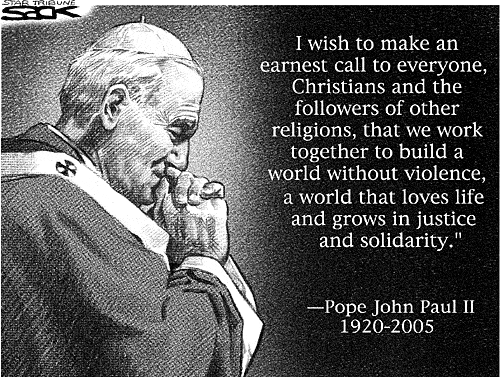
Pope John Paul II

April 17, 2005

Primacy of Conscience

I was recently pointed to this article by Rich (written by a Jesuit, but let’s not get into the “my authority can kick your authority’s ass” bit). It’s a bit dense, but not as dense as most writing on such issues. It makes some good points, and some that I don’t know that I agree with yet. My favorite part, I think, is near the end:

Where truth is in dispute, open conversation is needed. Truth requires freedom both to be recognised and to be credible. It is as counter-productive to withdraw topics like women’s ordination and contraception from public conversation as it was for communist regimes to ban advocacy of political systems different from their own. In any conversation where only one side may be argued, we instinctively assume that those who publicly defend the official position are motivated by ideology and not by an interest in truth. The outlawed position is then assumed to be true, and wins by default.

The argument must be eternal until all sides unquestioningly come to the same conclusion. Which is something I’ve thought about, and agreed with.

But… one wonders how this then compares to other taboo subjects, like arguments about racial equality—just because someone holds an opposing point, does that mean that the Truth is not apparent? Must one continue to hold that debate as long as there are people who insist on the “natural” inferiority of some races?

I’m thinking yes. One must debate, perhaps for the betterment of mankind, even if you feel yourself assured of the truth.

It’s almost an evolutionary argument, though—making the truth, determined over the long run and assuming that people cannot be convinced one way or another by the debate, merely a function of which position encourages sufficient amount of offspring. In a way, then, with those assumptions, “truth” must necessarily contain the “truth” of outbreeding your opponents, perhaps as an artifact of the search.

May 13, 2005

Mawwage is what bwings us togeva today

My mom sent me this article, which I found rather interesting. For example:

The origins of modern marital instability lie largely in the triumph of what many people believe to be marriage’s traditional role—providing love, intimacy, fidelity and mutual fulfillment. The truth is that for centuries, marriage was stable precisely because it was not expected to provide such benefits. As soon as love became the driving force behind marriage, people began to demand the right to remain single if they had not found love or to divorce if they fell out of love.

Such demands were raised as early as the 1790s, which prompted conservatives to predict that love would be the death of marriage. For the next 150 years, the inherently destabilizing effects of the love revolution were held in check by women’s economic dependence on men, the unreliability of birth control and the harsh legal treatment of children born out of wedlock, as well as the social ostracism of their mothers. As late as the 1960s, two-thirds of college women in the United States said they would marry a man they didn’t love if he met all their other, often economic, criteria. Men also felt compelled to marry if they hoped for promotions at work or for political credibility.

And the best part:

None of this means that marriage is dead. Indeed, most people have a higher regard for the marital relationship today than when marriage was practically mandatory. Marriage as a private relationship between two individuals is taken more seriously and comes with higher emotional expectations than ever before in history.

May 21, 2005

The Number of the Beast

So, according to the latest scholarship, the number of the beast is not 666, but rather, 616

Which is, amusingly, the area code of Grand Rapids, Michigan - naturally.

August 2, 2005

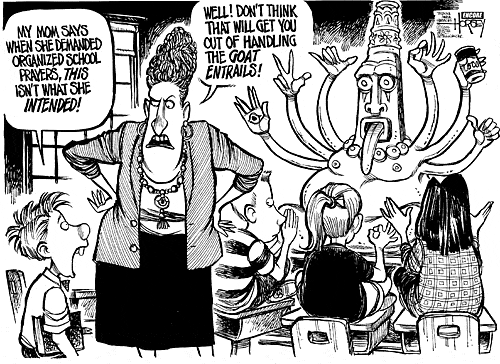
Mandatory School Prayer

August 28, 2005

Natural Family Planning

I’ve been thinking about natural family planning (NFP) recently. I’ve done some reading and a lot of thinking, and it strikes me as rather… contradictory. NFP is outlined in the Catholic Catechism, 2368-2370, which says:

2368
A particular aspect of this responsibility concerns the regulation of procreation. For just reasons, spouses may wish to space the births of their children. It is their duty to make certain that their desire is not motivated by selfishness but is in conformity with the generosity appropriate to responsible parenthood. Moreover, they should conform their behavior to the objective criteria of morality:
When it is a question of harmonizing married love with the responsible transmission of life, the morality of the behavior does not depend on sincere intention and evaluation of motives alone; but it must be determined by objective criteria, criteria drawn from the nature of the person and his acts criteria that respect the total meaning of mutual self-giving and human procreation in the context of true love; this is possible only if the virtue of married chastity is practiced with sincerity of heart.
2369
“By safeguarding both these essential aspects, the unitive and the procreative, the conjugal act preserves in its fullness the sense of true mutual love and its orientation toward man’s exalted vocation to parenthood.”
2370
Periodic continence, that is, the methods of birth regulation based on self-observation and the use of infertile periods, is in conformity with the objective criteria of morality. These methods respect the bodies of the spouses, encourage tenderness between them, and favor the education of an authentic freedom. In contrast, “every action which, whether in anticipation of the conjugal act, or in its accomplishment, or in the development of its natural consequences, proposes, whether as an end or as a means, to render procreation impossible” is intrinsically evil:
Thus the innate language that expresses the total reciprocal self-giving of husband and wife is overlaid, through contraception, by an objectively contradictory language, namely, that of not giving oneself totally to the other. This leads not only to a positive refusal to be open to life but also to a falsification of the inner truth of conjugal love, which is called upon to give itself in personal totality… . The difference, both anthropological and moral, between contraception and recourse to the rhythm of the cycle … involves in the final analysis two irreconcilable concepts of the human person and of human sexuality.

Now, let’s think about this a moment. 2368 clearly says that having more children is not always the best thing. If you cannot care for your children for some good reason, or cannot raise them properly, it makes sense that you should not, then, have more children. For example, if you’re just starting out, you’re on a grad-student’s salary—go ahead, and avoid children. This is pure necessity, and is endorsed by the Church as being a moral stance to take as well.

2369 reiterates that this does not mean you must abandon your marriage. A marriage has two parts, both “unitive” (uniting of the souls, bodies, persons), and “procreative”. The “conjugal act” they refer to there is sex.

Now we get to the real meat, here: 2370. First, it starts out by asserting that NFP, or as it is phrased here, “periodic continence” (frequently it is known as “periodic abstinence”), is an acceptable moral practice. Apparently, NFP respects the bodies of the spouses, and encourages education—which, objectively, it does. The goal is to observe the woman’s body (I’m all in favor of that), and learn what its cycle is, so that you can subvert that cycle and avoid that cycle’s primary function. But then the catechism contradicts itself. It says that “every action which, whether in anticipation of the conjugal act, or in its accomplishment, or in the development of its natural consequences, proposes, whether as an end or as a means, to render procreation impossible” is intrinsically evil. Now, lets ask ourselves, is that really “in contrast” to NFP? Well, does NFP propose, as its primary purpose, to render procreation impossible?

According to the pamphlet the United States Confederacy of Catholic Bishops distribute, With regard to spacing or limiting pregnancies, NFP is up to 99% successful when couples understand the methods, are motivated, and follow the guidelines. Now, 99% is not, strictly speaking, rendering procreation impossible. There’s always that little 1% chance. So, okay.

What we have to take from this is that, according to the Catholic Church, a method that is 99% successful at preventing pregnancy is still respecting the procreative nature of the marital union, because it does not make conception impossible. Now, that 99% figure is an interesting number because birth-control methods like condoms and hormone pills have approximately the same success rate, if not slightly less. If NFP is acceptable because it does not make conception impossible, then surely the use of a condom or a hormone pill is acceptable because they don’t make conception impossible either.

There does seem to be some disagreement about the effectiveness of NFP, though. According to an 1997 study by the U.S. Food and Drug Administration, in practice, NFP does not achieve its 99% effectiveness claim. According to them, the average rate of pregnancy when using NFP is 25% (75% effective), not 1% (though they say the lowest pregnancy rates were between 1 and 9%). Now, that’s a rather significant difference. Does that make NFP more acceptable, because it isn’t as effective a birth control mechanism? I would say no—the purpose of NFP is to not have children. According to the catechism, the benchmark that a birth control method must pass in order to be considered intrinsically evil is that the method must propose to make procreation impossible. Whether it is successful at achieving that goal or not, its intent—or what NFP proposes to do—is the same that using a condom or a hormone pill proposes to do.

Think of it this way—if you were aiming to commit suicide, a known sin, there are several methods of doing so. Would one method, for example, hanging yourself, be morally acceptable if it fails 25% of the time versus another method that is more successful and only fails 1% of the time—swallowing pills, say? (I have no idea what the actual success rates of suicide methods are.) Of course not. It matters that you’re attempting to commit suicide, not that you’ve chosen a particularly poor or a particularly effective method of doing so.

So, the catechism is either contradictory—it endorses NFP even though it makes pregnancy virtually impossible—or it is simply incomplete: perhaps it merely explicitly endorses NFP but only condemns contraceptive methods that ACTUALLY make conception impossible. This is certainly conceivable (sorry for the pun). What sort of sexual acts make conception impossible, then? I think this can only mean either the use of toys, complete abstinence, or even more bizarre things (like odd forms of cyber-sex, for example).

But … this is not the apparent position of the people who claim to know a lot about sex and who claim to espouse the Church’s position. These people claim that only NFP is an acceptable form of birth control and that all other forms of birth control are unacceptable—not only unacceptable, but immoral. We’ve established that the Catechism (or at least, the parts of the Catechism that I’ve read—and I’ve read a fair bit on this topic) either does not forbid the use of, say, a hormonal pill, or contradicts itself. As Sherlock Holmes once said, once we eliminate the impossible, whatever remains, however improbable (or difficult to believe) must be the truth. Presuming that the Catechism cannot contradict itself, it therefore must not be forbidding the use of more common forms of birth control. So, if we cannot use the Catholic Catechism, what reasoning can we use to support the “only NFP” stance?

I recently came across an article (okay, I admit, it was sent to me) from ThisRock, November 2003, titled God, Sex, and Babies: What the Church REALLY Teaches about Responsible Parenthood which, aside from sounding like some sort of exposé, attempts to make the case for the “only NFP” stance. I won’t quote the entire article here (you can read it yourself), but the author (Christopher West) makes some key relevant points:

  • Marriage consists of two parts, “incarnate” (physical) and “dis-incarnate” (meta-physical) love, which must not be separated: without one, you cannot have a valid marriage.
  • There is a life-giving nature to sexual love that echoes the love of God for His creation.
  • The use of bodily fluids in the sexual act is as important as the use of blood in the crucifixion of Christ.
  • God could not have performed Christ’s miracle of forgiveness without that bodily fluid.
  • NFP preserves the life-giving quality of sexual love.
  • Abstinence does not invalidate marital love.
  • Whether to have more children or not is a decision that should not be left solely to God.
  • There are many forms of selfishness when making decisions about whether to have more children, all of which are to be avoided.
  • You should justify the decision not to have children, not the other way around.
  • NFP is not a willful behavior and is as natural as an accident.

Now, some of his points are obviously incorrect. For example, contrary to his depiction, NFP is entirely willful behavior. Also, God can do whatever He likes, including make women pregnant who haven’t had sex at all: He is not restricted to using blood for His purposes. Some of West’s points are obviously correct, for example, that there are many forms of selfishness. And some of West’s points are directly contradictory, for example, that physical love is an indispensable part of marital love but that its absence does not invalidate that marital love. If we strip away those points, we’re left with:

  • There is a life-giving nature to sexual love that echoes the love of God for His creation.
  • The use of bodily fluids in the sexual act is as important as the use of blood in the crucifixion of Christ.
  • NFP preserves the life-giving quality of sexual love.

Now, the “life-giving quality” is an echo of the Catholic Catechism, which I’ve already discussed, so lets focus on the remaining argument. It makes a fair amount of sense, on the face of it. Some of the Church’s other religious observances center around some sort of bodily fluid—the blood and body of Christ in the Eucharist for example. So, we can forgive his rather bizarre justification for it (Hebrews 9:22, which only applies to men, not to God), and count this as a valid observation. Simple observation may not be sufficient justification for making it a rule … but lets give this the benefit of the doubt, and say: okay, the sexual act must not be modified in that sense in order to qualify as true marital love. The bodily fluids must mix.

When using a condom, of course, bodily fluids do not mix; that’s the whole point, after all. So let’s accept, for now, that the use of a condom is immoral, because it prevents the bodily fluids of the two people from mixing and therefore prevents the exercise of the sacrament. Condoms, of course, are not perfect, and only have a 99% success rate at preventing pregnancy, so there’s got to be some fluids mixing somewhere, but lets ignore that.

Where does this leave the use of other birth control methods like a hormonal pill regimen or spermicidal foam? Neither makes conception impossible, and neither prevents the mixing of bodily fluids. In the absence of a valid condemnation, one can only assume that they are absolutely permitted.

Well, that’s probably not the exactly right stance to take. Let’s go with a more Catholic stance, and fall back to the Primacy of Conscience. Now, given the name of the philosophy, you would think I would have started here, but I felt the need to address the more direct admonitions first.

This, though, is a much more personal thing. Having read about the issue, consult your conscience, and pray to God. Ask yourself and Him if NFP is a validation of the marital union or if the use of a hormonal pill regimen is a destruction and/or masking of the marital union. Ask God what about NFP is acceptable where other methods are unacceptable.

Here’s something to think about: hormonal pills may be used when the primary purpose is not birth control, but rather, hormone control. It may be desirable to control a woman’s hormonal cycle for all sorts of reasons, not the least of which is to prevent pain during menstruation. Some women release too much of their own hormones (or not enough) and thus undergo unusually painful symptoms (like debilitating cramps which can have serious consequences, such as infertility, if left un-treated); a hormonal pill regimen can help.

Come to your own conclusions. I’ve come to mine. You can probably guess what that is, too.

September 14, 2005

John F. Kippley, Chapter 11: The History of the Contraception Debate in the Church

I recently was given a copy of John F. Kippley’s book Sex and the Marriage Covenant: A Basis for Morality which, among other things, attempts to justify Natural Family Planning, or NFP. Remember, as far as I can tell, this stance is not supported by the Catholic Catechism so his task must be to justify it based on some sort of more direct scriptural evidence. He devotes a full third of his book, chapters 11, 12, 13, and 14 to what he calls “the Controversy”. That’s a LOT of text, so I’m going to examine them a chapter at a time. First, Chapter 11.

This is probably going to be a long one, so click the link to read the extended entry.

Continue reading "John F. Kippley, Chapter 11: The History of the Contraception Debate in the Church" »

October 2, 2005

Shouting Match

October 11, 2005

The Pedophilia Isn't the Worst Part

A report out from Philadelphia details the gross abuse of power and true mental sickness of the priests in power in that area. This is reported in an article in the National Catholic Reporter and an editorial in the same.

The report from Philadelphia explains how the two archbishops involved buried reports of sexual abuse specifically with an eye towards escaping the statute of limitations. Towards that goal, they were brilliantly successful: as a result of their efforts, the grand jury found that they could not indict any of the priests involved because the statute of limitations had expired.

And because of the way the archdiocese is set up legally, as an unincorporated association rather than a corporation, its officials also could not be prosecuted for crimes such as endangering the welfare of children, intimidation of victims and witnesses, and obstruction of justice.

“As a result, these priests and officials will necessarily escape criminal prosecution,” the report said. “We surely would have charged them if we could have done so.”

Despite most of the grand jury members, prosecutors, and detectives investigating the archdiocese being Catholics themselves, the Church decried an “anti-Catholic bias” and said the grand jury had tried to “bully and intimidate” the Cardinals. This same Church, which required a three year investigation and innumerable supoenas to get the information into the public, also decried the grand jury process as secretive and criticized the “tremendous power” of the district attorney.

One priest, Fr. Gerald Chambers, was transferred so many times—17 different assignments in 21 years—that according to the archdiocese’s records, church officials were running out of places to send him where his reputation for molesting children was not already known.

[Cardinal] Bevilacqua agreed to harbor a known abuser from another diocese, Fr. John P. Connor, “giving him a cover story and a neighborhood parish here because the priest’s arrest for child abuse has aroused too much controversy” in Camden, N.J.

Priests were even excused from being dismissed by virtue of committing
other crimes. For example:

[Fr. Stanley Gana] not only had sex with boys, he also had sex with women, abused alcohol and stole money from parish churches, the report said. So that is why Gana “remained, with Cardinal Bevilacqua’s blessing, a priest in active ministry,” the report said. “You see,” explained Lynn to one of Gana’s victims, “he’s not a pure pedophile.”

In another case, an abuser priest—Fr. John Gillespie—who wanted to apologize to his victims for his crimes—was transferred to another parish, not because he might molest his victims again, but because he might apologize to them, the report said. “If he [Gillespie] pursues making amends with others,” therapists at an archdiocese treatment facility warned, “he could bring forth … legal jeopardy.”

Some more interesting excerpts:

Another archdiocesan priest, Fr. Raymond Leneweaver, had T-shirts made for a group of altar boys that he abused, a group he named the “Philadelphia Rovers.” The priest repeatedly pulled one boy out of class in the parish grade school, took him to the school auditorium, forced the boy to bend over a table, and rubbed against him until the priest ejaculated, the report said.

While the cardinal knew of the priest’s proclivities, the parents of his unsuspecting victims did not. One father of an abuse victim, the grand jury report said, beat the victim and his brother, one to the point of unconsciousness, when they tried to tell their father of the abuse. “Priests don’t do that,” the devout father replied, according to the report.

One 14-year-old boy came to the priest for counseling after a family friend had abused him. “Fr. Gana used his position as a counselor and the ruse of therapy” to escalate the abuse.

“Notes in archdiocese files prove that the church leaders not only saw, but understood, that sexually offending priests typically have multiple victims, and are unlikely to stop abusing children unless the opportunity is removed,” the report said.

“In the face of crimes they knew were being committed by their priests, church leaders could have reported them to police,” the report said. “They could have removed the child molesters from ministry, and stopped the sexual abuse of minors by archdiocesan clerics. Instead, they consistently chose to conceal the abuse rather than to end it. They chose to protect themselves from scandal and liability, rather than protect children from the priests’ crimes.”

“The grand jurors find that, in his handling of priests’ sex abuse, Cardinal Bevilacqua was motivated by an intent to keep the record clear of evidence that would implicate him or the archdiocese,” the report said. “To this end, he continued many of the policies of his predecessor, Cardinal Krol, aimed at avoiding scandal, while also introducing policies that reflected a growing awareness that dioceses and bishops might be held legally responsible for their negligent and knowing actions that abetted known abusers,” the report said.

When the priest pedophilia scandal broke in Boston, Bevilacqua tried “to hide all he knew about sex abuse committed by his priests,” the report said. He had his spokesperson tell the media in February 2002 that there had been only 35 priests in the archdiocese credibly accused of abuse over the last 50 years, even though the archdiocese “knew there were many more,” the report said. The grand jury put the number of abusive priests at 63.

The cardinal also announced to the public in April 2002 that no priest with accusations against him was still active in ministry, even though several still were. “He certainly was not credible when he claimed before this grand jury that protecting children was his highest priority—when in fact his only priority was to cover up sexual abuse against children,” the report said.

From the editorial:

Next month the U.S. bishops gather for their annual meeting… . The bishops in that meeting room in Washington will know that the truth finally came out in Philadelphia not because the diocese decided the community deserved to know it, but because prosecutors relentlessly pursued it.

Of what use are we as a believing community if we can’t get this right? Who cares what our chalices are made of or what gender pronouns we use in our prayers or what we say about the unborn or the poor or anything else in our moralizing agenda if we can’t tell the truth about what happened to our children?

October 30, 2005

Intelligent Design

I found a pair of excellent arguments against Intelligent Design: here and here

Here’s my favorite of the two:

A newer, alternative view provides balance to the age-old argument, pitting creationism against evolution. It’s called intelligent design. It studies the science of intelligence or intelligent life.

This his simply a lie, and I thought Christians were not allowed to lie. Intelligent Design doesn’t study anything, ID has postulated a set of theories that are beyond study and therefore not scientific, even if, by an astonishing miracle ID was a correct description of the world, it would be wrong to teach it in science class.

Intelligent design can and has been proved scientifically.

This is another lie, the Christian is really going at it today. ID has never been tested simply because it is not testable. Also, the sentence above shows with utter clarity why you are so amazingly wrong, you are just ignorant. Science, outside of a rather narrow field, doesn’t deal with proving things much, it deals with falsifying things, and the difference is enormous.

Intelligence leaves behind a characteristic signature.

This could probably said to be true, close to the first true sentence in your posting. There is a huge problem with it though, there is no characteristic signature in life that would imply intelligent design.

I propose the followers if the ID ideology change the name of it to BSD. The Theory of Bloody Stupid Design. You see, in all the life we see around us there is evidence after evidence of a Bloody Stupid Designer, if you look. A few examples:

  • Why is mankind created with a spine that is perfectly designed for waking on all fours when we walk on two? In fact, the spine is designed so horribly badly for bi-pedal movement that any engineering student could do significantly better after the first 6 months in engineering school.
  • What kind of idiot would design a sea-living mammal like the whale, with the remnants of legs inside its lower abdomen? What on earth would a whale do with legs in it’s abdomen?
  • The human pain system is designed in a marvellously stupid way. If I suffer from a small amount of tooth decay, I suffer significant pain, this in spite of the fact that the tooth decay is not at all dangerous to my life. On the other hand, if I get a cancerous growth in my lungs, I notice nothing until it is too late to save my life. What kind of moron would design a warning system like that?
  • Several parts of my internal organs, the appendix being a notable one, is designed in such a way that inflammation, and until quite recently - death, follows. This in spite of the fact that the dumb thing serves no purpose whatsoever! Would you praise GM for having a nonsensical device in your car that blows your engine to pieces if it rains for three days in a row?
  • The eye is a fantastically complex mechanism, but it has a design flaw, very minor, but the design flaw reduces the accuracy of the eye with as much as 50%. Why on earth would you be dumb enough to do that in humans? The design flaw would be trivial to fix if you designed a human from scratch.
  • A bi-pedaled entity like the human would be able to walk faster, suffer less back pain and in general be far healtier if our knees were jointed the opposite way of the way they are. What kind of moron would give us knees that work great if you walk on all four, but not so well when you walk on two?

The list goes on and on. There is no trace of any intelligence whatsoever in our design, but there is a lot of traces of random changes, adaptation of body-parts to jobs they are not particularly well suited for etc. If there was someone behind the design of humans, he would fail Human Design 101. Bloody Stupid Johnson.

October 31, 2005

Intelligent Design Again

I found a very good, very thorough (though less amusing and less abrasive) explanation of why Intelligent Design is pseudoscience with no place in a legitimate discussion of science, here. It’s very long, but very good. It goes into great detail about the primary tenets of the Intelligent Design ideology which is good for background. Here is the cut-to-the-quick part that explains why Intelligent Design is entirely pseudoscience:

While proponents of Intelligent Design pretend to be scientists, this is not the case. Intelligent design does not meet the accepted standards of the scientific community for being a scientific theory. There is a concept in the philosophy of science of falsifiability. Karl Popper writes of this in his book, The Logic of Scientific Discovery:

“…All the statements of empirical science (or all ‘meaningful’ statements) must be capable of being finally decided, with respect to their truth and falsity; we shall say that they must be ‘conclusively decidable’. This means that their form must be such that to verify them and to falsify them must both be logically possible. Thus Schlick says: ‘…a genuine statement must be capable of conclusive verification’; and Waismann says still more clearly: ‘If there is no possible way to determine whether a statement is true then that statement has no meaning whatsoever. For the meaning of a statement is the method of its verification” (17)

Intelligent Design obviously does not fit this criterion. As should be clear by now, there is little if any evidence for Intelligent Design, but this does not prove it to be false. It is, in fact, impossible to prove it false. However unlikely it is that some form of intelligence created the universe, there is no way to verify or falsify the claim. God is invisible, we are told. He is undetectable. This is in contrast to Darwinism, which could easily be falsified if it were shown that some creature just appeared out of thin air, without any ancestors (though this may be difficult to prove, it would not be impossible). Therefore, Intelligent Design fails the test of falsifiability, and is therefore not a valid scientific theory.

One of the comments on the article makes an excellent point that suggesting that God needs to tamper with creation presupposes that an omniscient and omnipotent God couldn’t have set the universe up to be exactly what He wanted from the beginning. He created it, so He could let things evolve into the result he desires. Instead, pushing for Intelligent Design, the poster suggests, is a sign of zealotry and lack of respect for God’s power to design a universe where cause-and-effect are used to create precisely the design God wants. As God is outside of time, evolution may be merely one of God’s masterful brush-strokes across time. Intelligent Design encourages you to stop looking for causes and to stop trying to understand creation by simply claiming that because you obviously know the creator and have full and perfect knowledge of the creator, you no longer need to worry about the details of creation. In a way, science is the pursuit of the causal chain, and Intelligent Design proposes to cut short the chain of causality by stating that the far end of the chain of causality is an “intelligent designer” and that that is all you need to know.

Here’s an excerpt from a very funny editorial from Scientific American:

Moreover, we shamefully mistreated the Intelligent Design (ID) theorists by lumping them in with creationists. Creationists believe that God designed all life, and that’s a somewhat religious idea. But ID theorists think that at unspecified times some unnamed superpowerful entity designed life, or maybe just some species, or maybe just some of the stuff in cells. That’s what makes ID a superior scientific theory: it doesn’t get bogged down in details.

November 12, 2005

Evolution, sayeth the Vatican

I found this article, reproduced here for archival purposes.

Continue reading "Evolution, sayeth the Vatican" »

December 14, 2005

Ten Commandments

This is mostly intended to be a bit of a record…

At the RCIA meeting last night, the topic of discussion was the ten commandments. Now, you’d think they’re pretty straight-forward, but, of course, the consequences of straight-forward commandments are pretty complicated. Here’s just what caught my attention:

From the first commandment, the This is Our Faith book talks about many things, including a reference to simony, as a sub-category of irreligion. Now, like me, you’re probably wondering what simony is. According to Apple’s dictionary, it is:

The buying or selling of ecclesiastical privileges, for example pardons or benefices.

Which is about the same as the brief definition given in that book. Summary: selling indulgences is A SIN. Good call, Martin Luthor!

Next up: taking the Lord’s name in vain. Now, what I found interesting about this is the varying interpretations of what that exactly means. I mean, the Lord’s name, strictly speaking, is Yahweh, not “Lord”. Actually, I suppose, the Lord’s name is also Jesus Christ, though to some extent that’s the name Mary gave him, not the name that is his inherently. So, does just saying “oh, God!” when surprised, frustrated, or whatever qualify? Probably not—-that’s taking the Lord’s title in vain. Essentially, like the difference between “George W. Bush” and “Mr. President”. Another question: what does it mean to take it in vain? I mean, if you’re shouting it in surprise or in glee, is that in vain? Next question: why is it phrased taking the Lord’s name? I don’t know that saying something has ever been referred to as “taking” in any other context. On the contrary, when we say “he took my name”, we generally mean that he assumed my name, and called himself by my name. This makes more sense as a commandment: don’t call your children God or Yahweh, because that name is reserved and your taking the name would be in vain because you are not God.

So why do we think of “taking” the Lord’s name in vain as using it as an exclamation?

The “This is Our Faith” book also describes failure to attend Sunday mass as mortally sinful. This seems interesting, and prompts the question: what is the difference between regular sin and mortal sin? According to Fr. Bill, regular sin weakens your relationship with God while mortal sin destroys it. Next question: does skipping mass on Sunday once destroy your relationship with God? Not going ever, that may be more of a mortal sin, but skipping for whatever reason? Hardly seems mortally sinful.

On the other hand, we have the fabulous example (and I use the term sarcastically) of megachurches, nationwide, deciding not to hold services on Christmas (Fort Wayne, IN and Miami, FL and Des Moines, IA and Kentucky and Texas to name a few). Yeah, that makes lots of sense.

An interesting note about some of the Laws of Moses: remember the whole eye-for-an-eye thing in there that seems kinda barbaric and unmerciful? Something to think about is that at the time, common practice was that if you poked out my eye I’d poke out six of your kinsmen’s eyes (minimum). In that framework it was shockingly merciful, and we’ve merely progressed as a society towards more and more mercy.

Anyway, the fifth commandment was, as always, a fun one. First up: abortion. Now, this is just a minor quibble with the This is Our Faith book, but it claims that Christians have always believed that personhood begins at conception and that killing a fertilized egg or an embryo or a fetus has always been considered murder. This is totally not true, as can be discovered by reading a little of Saint Augustine’s works. Specifically, he references Exodus 21:22-25:

When men have a fight and hurt a pregnant woman, so that she suffers a miscarriage, but no further injury, the guilty one shall be fined as much as the woman’s husband demands of him, and he shall pay in the presence of the judges.

But if injury ensues, you shall give life for life,

eye for eye, tooth for tooth, hand for hand, foot for foot,

burn for burn, wound for wound, stripe for stripe.

And points out that the life within the woman is worth merely a fine, while the penalty for any injury to the woman is far more severe, indicating that the unborn child is not worth as much. Granted, there are plenty of good arguments to say that Exodus gives an incorrect balance of punishments (particularly in this case), but the fact of the matter is that the Church has not always felt that unborn children were living in the same sense that the mother is living.

Now, of course, when talking about “thou shalt not kill”, one always comes face to face with things like war and how the Church endorses the concept of Just War. And a straightforward, simplistic reading of this says: hey, the commandment is not ambiguous! It doesn’t say “thou shalt not kill, except when you really have to”, it just says “thou shalt not”. The concept of Just War is predicated on the concept of self-defense as a basic right. And I was originally a little confused about where such a so-called basic right comes from, until another RCIA member pointed out that lack of self-defense is murder! If someone is going to kill you and you do nothing, it’s no different than committing suicide. Killing is still wrong, of course, but when it’s unavoidable… then it’s a wash. Which is somewhat more firm ground, but illustrates just how limited a concept Just War really is.

Here’s another question I don’t have an answer to: is smoking morally equivalent to suicide?

Fr. Bill told us to look up Gerry Powers, Professor Emeritus of Boston College, who has made many interesting arguments about the concept of Just War, particularly as it applies to Iraq.

There was a little bit of talk about the Catholic sexual ethic, which I’ve already talked about (and no new issues were raised here). An interesting point came out of the This is Our Faith paragraph about masturbation. Specifically:

Inexperience, habit, or circumstances, however, can diminish our blameworthiness in this area as we grow to maturity.

When I asked him about it, Fr. Bill said that this concept holds true for just about every sin: sometimes there more to avoiding it than just not doing it (this even refers back to the ideas substantiating self-defense). This, of course, also points to the concept of the Primacy of Conscience, since circumstances are important in considering the blameworthiness of a person for any sin. Interesting, no?

The This is Our Faith book also outlines some pretty… strict prohibitions about the use of fertility and other pro-conception methods, such as using donated sperm (a no-no, because it interferes with the closeness of the couple (what? I think circumstances will bear out the un-blameworthiness of this one most of the time)). This prompts the question, for me (I didn’t raise it at the RCIA meeting) of: if an unborn child is essentially no different in any particularly important spiritual respect than a child that has already been born, what’s the difference between having a test-tube baby implanted in the womb of a mother and straight-up adoption? I think the Church (or the This is Our Faith book) is a little wrong here in banning anything but classical conception.

My last observation: The eighth commandment against bearing false witness does NOT specify that you may not knowingly bear false witness, it merely forbids bearing any kind of false witness. Specifically, that seems to me to be a commandment to verify whatever information you pass along before you do it (i.e. don’t spread rumors!). Fr. Bill didn’t seem to want to come with me on that one, but he may not have quite understood me (or I may be wrong in reading that into the wording).

Oh, and Fr. Bill read a bunch of amusing passages from Deuteronomy to demonstrate how really silly it could get. For example, Deuteronomy 23:10-12:

“When you are in camp during an expedition against your enemies, you shall keep yourselves from everything offensive.

If one of you becomes unclean because of a nocturnal emission, he shall go outside the camp, and not return until,

toward evening, he has bathed in water; then, when the sun has set, he may come back into the camp.

Yup, they even have rules for that.